Skip to content
S1
Session One
Public-market research terminal

Value any stock.See every assumption.

Multi-archetype DCF, Monte Carlo simulation and method diagnostics on any US-listed ticker. One workflow, and every number shows its work.

Popular
Session One · Equity ResearchDemonstration · values from a real product run

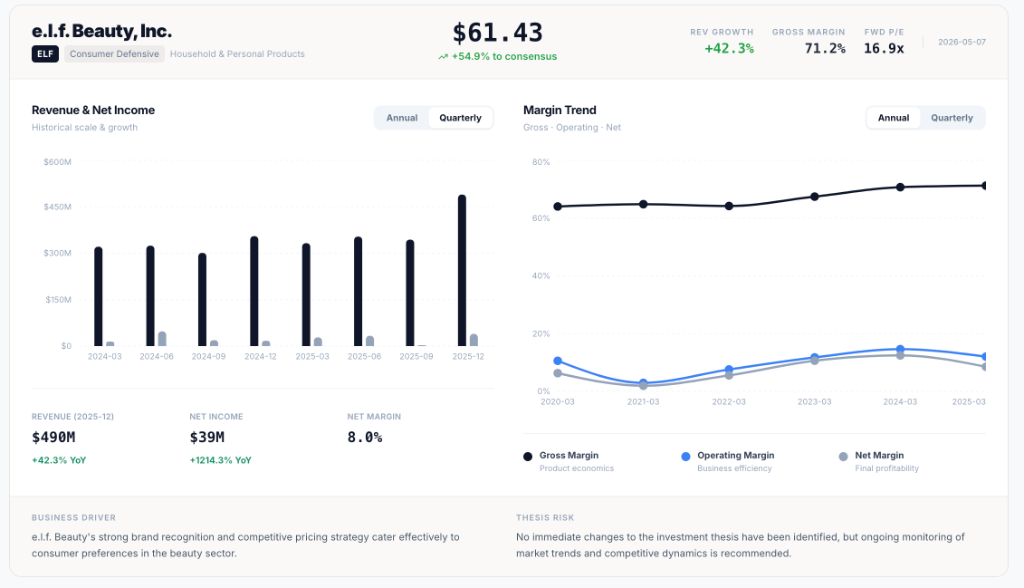
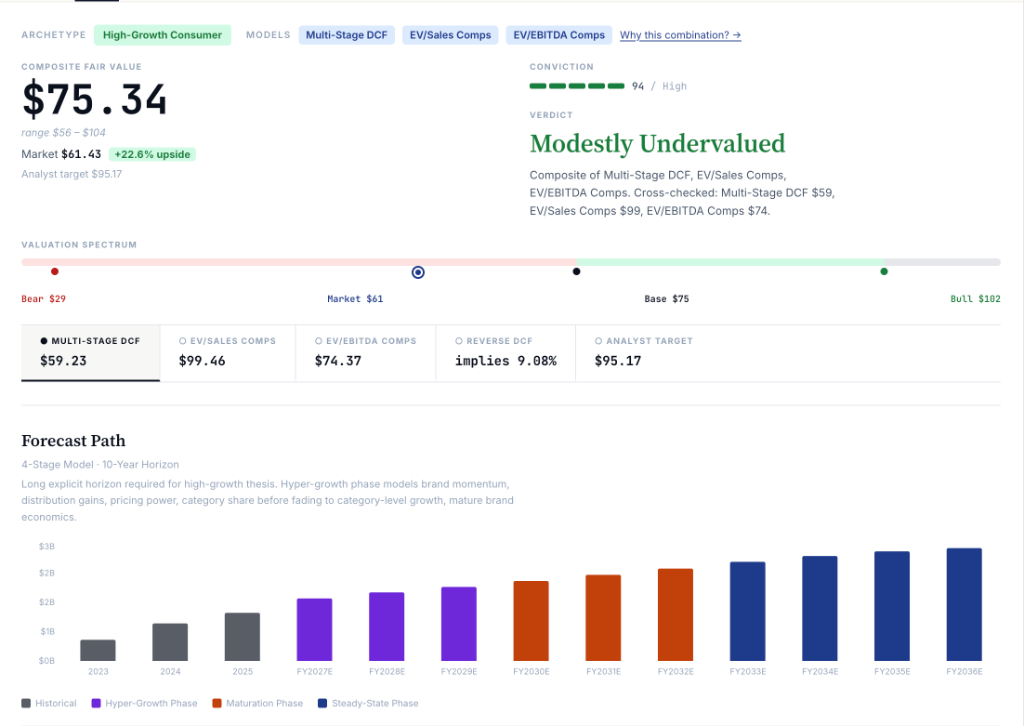
In this demonstration from a real product run, typing E, L, F finds E.l.f. Beauty, Inc. (ELF, NYSE). The engines complete: the archetype classifies as 1 of 22, the DCF finishes, the simulation runs 10,000 paths, three future paths are priced, and peers are read inside the archetype. The composite value is $75.34 against a market price of $61.43, read as Modestly Undervalued. From the run: revenue growth +42.3%, gross margin 71.2%, forward P/E 16.9x. Every assumption is listed next to the number.

One real run, shown end to end.

01 · At a glance

Today on the desk.

Five sections, one reading habit. Start anywhere.

DCF valuation output in Session One — composite fair value with listed assumptions
Equity Research
Multi-archetype DCF and a 10,000-path simulation on any US-listed ticker.

Composite fair value, verdict and every assumption behind them.

Real product capture
Run a valuation
Portfolio Lab
Stress scenarios across a full book.

Rate, growth and sector shocks, tested before they arrive.

Verified product feature
Stress a portfolio
Sector Heatmap
Sectors compared side by side in one grid.

One screen for relative sector strength.

Verified product feature
Compare the sectors
Macro Overview
US CPI 3.5%, the first decline in five months.

The day's macro, read in one pass.

Curated · Jul 2026
Read today's brief
Capital Flows
$1,300.5B deployed by the S&P 500 last quarter.

Capex, buybacks, dividends and R&D, quarter by quarter.

Session One · Q1 2026 · computed from filings
Trace the capital cycle
Also on the desk: Market Pulse · Forecasting Lab · Charts LibrarySession One is research and educational analysis, not investment advice.
02 · How a run works

Ticker in, reasoned number out.

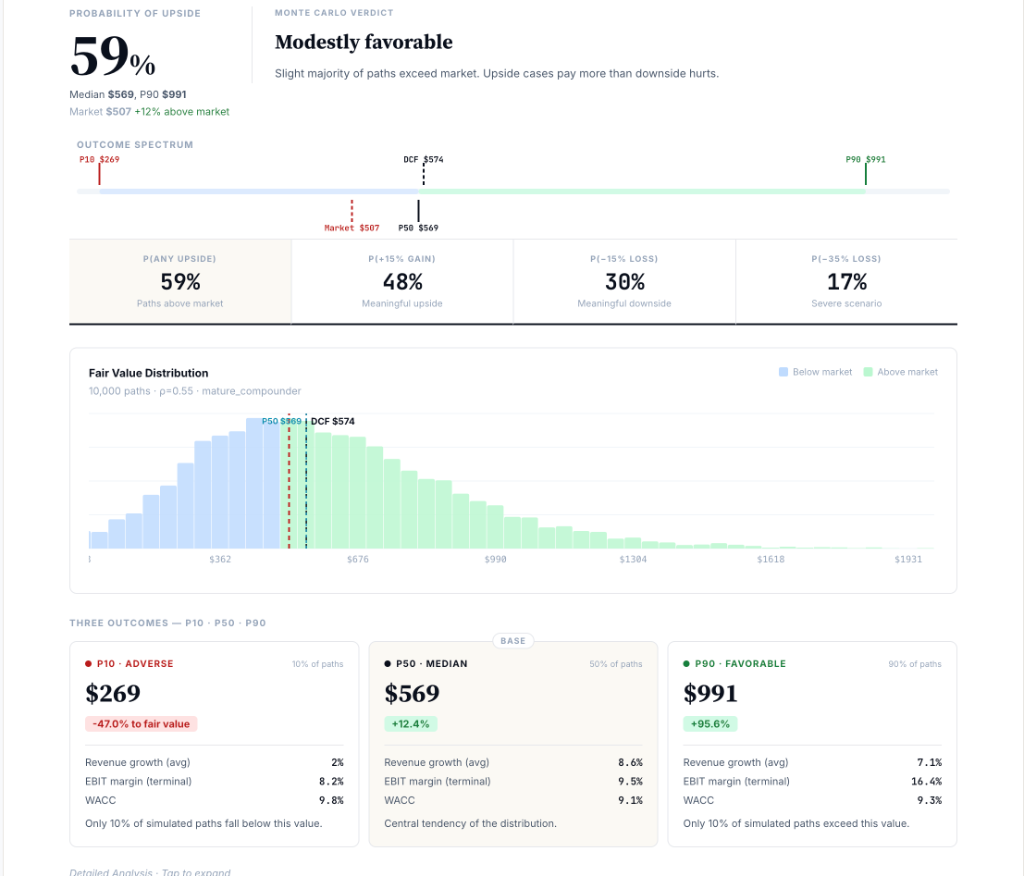
How a run works, in four steps. Step one, type a ticker: any US-listed company; suggestions rank the largest first. Step two, classified: one of 22 valuation archetypes sets the method before any math. Step three, the engines run: DCF, a 10,000-path simulation, three scenarios, peer comparison. Step four, the number, defended: every assumption listed next to the output. The full read is shown in section five.

What you walk away with
The number and its range.The full assumption listThree scenario pathsPeer context inside the archetype
03 · The workbench

Four engines. One research workflow.

Each engine produces a number, a range, and the reasoning behind both, so a thesis rests on structure, not instinct.

One fair value, assumptions attached.

An FCFF DCF with an 8-year explicit forecast by default: archetype-calibrated WACC and terminal assumptions, excess-return routing for financials, and every assumption listed next to the output.

DCF valuation output in Session One — composite fair value with listed assumptions

DCF valuation output: composite fair value with its assumptions listed.

Real product capture
DCF EngineFCFF with an 8-year explicit forecast; archetype-calibrated WACC and terminal assumptions.
Monte Carlo10,000 paths per run; the fair value becomes a distribution, not a single point.
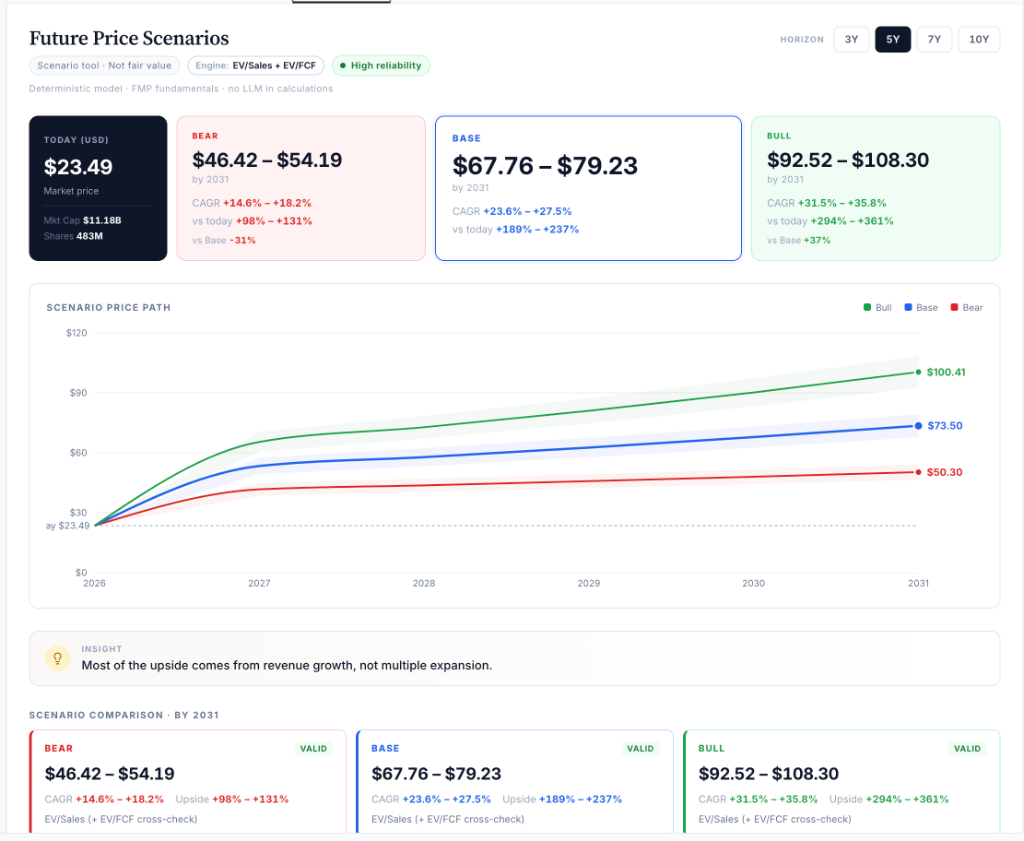
Future ScenariosThree explicit paths priced side by side before a position is sized.
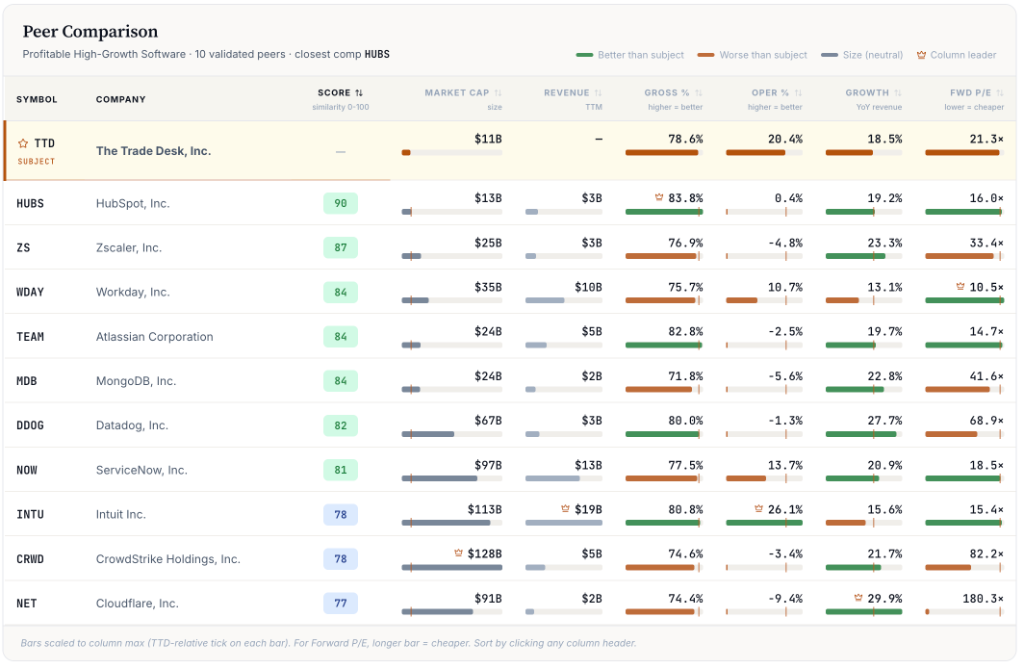
Peer ComparisonMultiples read inside the company's archetype, not against the whole market.
04 · Archetype routing

Twenty-two archetypes. One model that adapts.

Banks aren't priced like SaaS. Every company is classified into one of 22 valuation archetypes, each with its own method registry, WACC calibration and margin logic, before a single number is produced.

Deterministic classification: rules and hard overrides, not an LLM
8-year explicit forecast by default, with stage decay
Excluded valuation methods listed with the reason
Auto-classified archetypeReal product capture
DCF valuation output in Session One — composite fair value with listed assumptions
05 · The report

Every run ends in a report you can defend.

One ticker in. Four parts out. Nothing hidden in a footnote.

Real product capture
Equity Research overview page in Session One — company snapshot and valuation summary
  1. The verdict and composite fair value
  2. The drivers behind it
  3. The standing risk note
What you walk away with
A number you can interrogate, with its range
The full assumption list, in the open
Three scenario paths, priced side by side
The risk note that keeps the read honest
06 · Method

A paper trail behind every number.

Named sources

Market data from Financial Modeling Prep, macro data from the IMF WEO, filings from SEC EDGAR. The source is printed next to the number.

Model-derived reads, labeled as such

Interpretations are rule-based and carry a Derived badge; raw data carries an Observed badge. The two never blur.

Not investment advice

Session One is research and educational analysis. Outputs depend on assumptions, and figures may be delayed or cached.

Real product capture— an unedited screenshot of the product.
Verified product feature— confirmed in code before it is claimed.
Curated · Jul 2026— a sourced figure entered by hand, dated.
Session One · Q1 2026 · computed from filings— calculated by our models from filings or data.

The same labels appear inside the terminal.

22
valuation archetypes
4
engines, one workflow
10,000
Monte Carlo paths per run
8-year
explicit forecasts
07 · Who it's for

The analyst desk, in one tab.

Three workflows: deep valuation, daily macro context, and portfolio stress. Pick the one your next decision needs.

Independent investors

Fair value frameworks, not hot takes.

You know the company. You need the number, the method, and three scenarios before you size the position.

Equity Research → DCF → Scenarios
Explore Equity Research
Active market participants

Context before entry. Always.

You react fast. Session One puts a macro read, the day's catalysts and a fair-value check in front of every idea.

Macro Overview → Market Pulse → Equity Research
Explore the macro desk
Portfolio builders

Concentration is a position. Own it.

Test your full book against rate, growth and sector shocks, before the market runs the test for you.

Portfolio Lab → Stress Test → Forward Path
Open Portfolio Lab
08 · Pricing · Founding access

One terminal. One price.

Founding member access
€49/ month · founding price
All four valuation engines: DCF, Monte Carlo, Future Scenarios, Peer Comparison
22 valuation archetypes, auto-classified
10,000-path simulation runs
8-year explicit forecasts
The macro desk: Macro Overview, Market Pulse, Quarterly Capital Review
Portfolio stress testing in Portfolio Lab
Free to start. No credit card required.

Billing launches later: founding members keep the founding price.

What the price covers

Institutional terminals list from roughly €12,000 to €24,000 per year.

All engines

DCF, the simulation, Future Scenarios and Peer Comparison on every run.

Macro coverage

Macro Overview, Market Pulse and the Quarterly Capital Review.

Portfolio stress

Stress testing across a full book in Portfolio Lab.

09 · Questions

Asked before you ask.

14 of 14 answers

Answers come from Session One's published pages. Not investment advice.
Start with one ticker.

Multi-method valuation with the work shown.